Operational Profile of our Ion Engine
The ABIE engine has the capability of being utilsed in a number of ways, from terrestrial to deep space exploration.
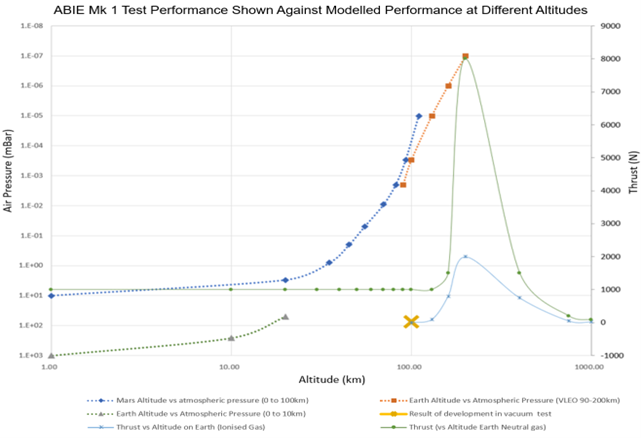
shows the results of the Quanta Engineering ABIE in vacuum testing (yellow cross) against the simulated performance (solid lines) of the ABIE at different altitudes. The dotted lines show air pressure with respect to altitude on Earth and Mars.
Applicability of the ABIE to Space Missions
The figure above illustrates the applicability of the ABIE to space missions by comparing thrust output against altitude. It presents the theoretical performance of the ABIE across a range of altitudes within both the Earth's and Mars' atmospheres, while also highlighting the actual performance achieved by the Mk 1 ABIE during proof-of-concept testing.
The graph combines six separate datasets into a single figure, enabling direct comparison of operating conditions and performance characteristics.
The first three datasets show the relationship between altitude and atmospheric pressure for Earth and Mars, defining the regions in which the Mk 1 engine can operate.
- Dataset 1 – Earth Atmosphere (Green Dashed Line)
The first dataset represents engine operation within the Earth's lower atmosphere, from sea level up to an altitude of 20 km, which is approximately the maximum cruising altitude of commercial aircraft. This dataset demonstrates the expected operating range of the ABIE within the denser regions of the atmosphere.
- Dataset 2 – Earth Upper Atmosphere (Red Dashed Line)
The second dataset shows engine operation between altitudes of 100 km and 1,000 km above Earth. This range extends from the Kármán line, commonly recognised as the boundary between the Earth's atmosphere and outer space, to Low Earth Orbit (LEO).
The 1,000 km altitude should not be interpreted as the maximum operational altitude of the ABIE. Rather, it was selected as a practical upper limit for the performance calculations presented in this study.
The engine is theoretically capable of operating within both the green and red dashed regions. However, operation within the intermediate altitude range of 20 km to 100 km will require modifications and upgrades to the electronic control systems before sustained operation can be achieved.
- Dataset 3 – Mars Atmosphere (Blue Dashed Line)
The third dataset represents the expected performance envelope for operations within the Martian atmosphere, covering altitudes from the Martian surface up to 100 km above ground level.
- Dataset 4 – Neutral Air Operation (Solid Green Line)
The fourth dataset is a computer-generated simulation of thrust output at altitudes ranging from sea level to 1,000 km on Earth while operating in neutral atmospheric gases. In this mode, an ioniser is required to ionise the gas passing through the engine before thrust can be generated.
- Dataset 5 – Ionospheric Operation (Solid Blue Line)
The fifth dataset is a computer-generated simulation of thrust output between 100 km and 1,000 km altitude on Earth while operating within the ionosphere. In this environment, the engine is able to utilise naturally occurring ions present in the atmospheric flow and therefore does not require an onboard ioniser.
- Dataset 6 – Mk 1 ABIE Test Performance (Yellow Cross)
The sixth dataset, represented by a yellow cross, shows the actual performance achieved by the Mk 1 ABIE during proof-of-concept testing. The test was conducted at a simulated Earth altitude of 100 km and provides the first experimental validation of the engine concept.

Isp of the engine
the engines profile is unique, at high atmospheric densities, the Isp is low making it ideal for urban environments, but as the density decreases, the Isp increases.